

The agent, whose name can’t be revealed, testified at the drug and firearms trial of a former Nanaimo Hells Angels member and associate that he was paid $385,000 to provide information and evidence.
A key Crown witness in the trial of a former Nanaimo Hells Angels member and an associate testified Monday under cross-examination that he was paid roughly $385,000 to provide information and evidence to police over the course of nearly a year.
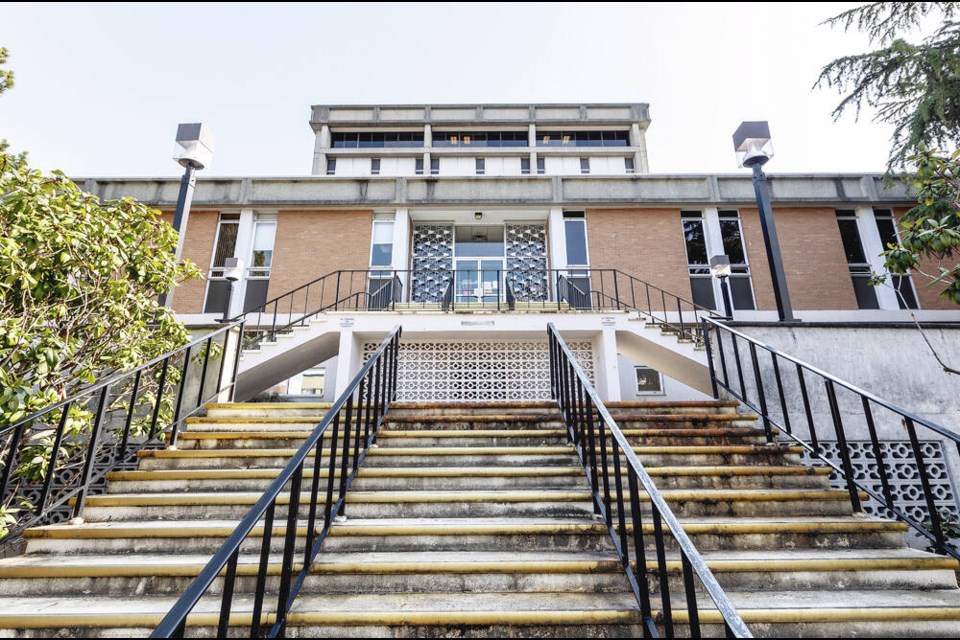
The man, whose identity is protected by a publication ban, has been on the stand since last week in the trial of Kristopher Stephen Smith and William Bradley Thompson. The two men were charged in November 2022 after a joint investigation by the Combined Forces Special Enforcement Unit of B.C. and the RCMP’s Federal Serious Organized Crime unit.
Smith faces five charges, including two for trafficking cocaine, and one each of trafficking oxycodone, possessing a non-restricted firearm without a licence and transferring a firearm without authorization.
Thompson is facing eight charges involving the possession of prohibited and restricted firearms and possessing non-restricted firearms without a licence. He also faces a charge of possessing cocaine for the purpose of trafficking.
Together, they face a charge of transferring a prohibited firearm, an Uzi Model A nine-millimetre semi-automatic gun, on Feb. 25, 2020, while knowing they were not authorized to do so.
The Crown witness, a former member of a “puppet club” for the Hells Angels, agreed under cross-examination Monday that while considering whether to become a police agent — which involves taking directions from officers to conduct certain interactions and handing over information and evidence — he asked how much money he could make.
When first asked by an officer if he would consider becoming a police agent, the man said he had gone to jail because of a police agent who provided information on him, and he would have to think about it, he testified.
The man began supplying some information to police around 2017 before becoming an official confidential informant in April 2018, he said. He had to wait until he was done with parole to be confirmed as an official confidential informant, he testified.
In September 2019, he signed an agreement to become a police agent and began taking directions from police.
He testified earlier in the trial that as a police agent, he would be instructed to attend a “bat cave,” where he would often be wired up and shuttled to a safe house for a briefing by officers on what they wanted him to do. After interactions with targets of the investigation, he would return to the bat cave, where police would remove evidence from his vehicle and take him to the safe house to debrief.
The month after his initial agreement to become a police agent, he signed a second letter of acknowledgement with police, setting out an updated payment agreement for his work as a police agent.
His monthly stipend was set at $8,500, and an award payment to be determined by the RCMP was set at a maximum of $250,000, defence lawyer Kelly Bradshaw put to the man. He agreed.
The agreement also included an award payment of up to $100,000 to be paid upon the conclusion of the investigation and up to $75,000 at the conclusion of all preliminary inquiries in court.
“Did you receive that payment?” Bradshaw asked.
“Yes,” he said.
The agreement included another payment of up to $75,000 at the end of all legal proceedings, Bradshaw said.
“And I take it that payment is still pending,” she said.
“Correct,” the man replied.
He agreed he was paid an additional $100,000 on top of those amounts.
“So how much in total were you paid as a police agent since September 9, 2019, until August 2020?” Bradshaw asked.
The man said he wasn’t sure of the total stipend amount, but the awards added up to $275,000.
He received $51,000 in stipend payments by August 2020 and another $59,000 in award payments, Bradshaw said.
That brought his total payments to $385,000, the man said.
Bradshaw suggested to the man that he encouraged Smith to continue working toward becoming a full-patch Hells Angels member when Smith wanted to quit the program, saying it would make Smith’s life better.
The man said he didn’t recall Smith wanting to quit while he was a prospect or saying it would improve his life.
“I would imagine it occurred to you that if [Smith] was a Hells Angels member, that would be beneficial to your goals of becoming a police agent,” Bradshaw said.
The man said he hadn’t yet committed to becoming a police agent at the time, but he realized information could be more lucrative.
Smith received his full patch in late 2018, the man said. That was while the man was a confidential informant, but before he became a police agent.
Bradshaw questioned the man about his criminal activity while acting as an informant and a police agent.
“So you’re trafficking in cocaine while you’re trying to become a police agent,” Bradshaw said. “At the same time, you’re informing on Kris Smith for his activities.”
He agreed.
Bradshaw said a warrant went out for the man’s arrest in September 2019, shortly after he became a police agent. His police handlers advised him to turn himself in, which he did.
He was processed and released the same day, he said.
His handlers directed him to leave the province four times, even though he was under a condition not to leave B.C., Bradshaw put to him.
The man said it was an oversight.
“I handed them my paperwork and that was my focus — doing the scenarios and doing as I was directed,” he said.
Officers involved in the investigation are expected to testify on Thursday.
regan-elliott@timescolonist.com
Source: Times Colonist
- Indiana judge’s shooting linked to motorcycle club and failed bid to block trial testimony, authorities say

- Olympic boxer, outlaw biker Phil Boudreault dies at age 50

- Wild LI biker brawl between Pagan’s, Hell’s Angels leads to sweeping felony case
- H.A. & Pagans Indicted While Black Outlaws Party – Open Biker Talk

- Tampa City Council votes down ordinance banning wheelies and large biker groups on Bayshore, Riverwalk

- Pinconning man charged with torching Outlaws Motorcycle Clubhouse in Saginaw
- Keys motorcycle gang member arrested on charge of soliciting teen girl for sex

- Mongols biker gets 5 years for rioting at gas station during Bike Week
- Massive Crackdown on Comancheros in New Zealand: Nearly All Members Facing Charges
- Man Sentenced for Supplying Shotgun to Comanchero Gang Associate

- Cherokee Family Motorcycle Club’s Ninth Annual Jacksonville Toy Run

- Alleged B*EAST MG member who is an ex-constable deputy pleads guilty to murder in shooting of rival Sun Devils MC Member
- Recent Hells Angels Clubhouse Forfeitures in B.C.: What to Know

- B.C. Govt Aggressively Targets Hells Angels by Suing to Seize their Clubhouses, Especially Langley
- Toys needed for the 2025 Tijuana Toy Ride
 Black Dragon Biker News